
Crowd Surfers
2025 - 2026
TL;DR
Crowd Surfers is a game about Slip, a pizza delivery skater dodging crowds and buildings in a dense, noisy city. He’s trying to get pizzas to the door before his game-show-host boss fires him. A fully student-run club of more than 100 people at UC Santa Cruz built it, and you can play it on itch.io.
The contribution I care most about was a decision rather than a feature. Partway through the project I convinced the team to tear out and rebuild how the game renders, moving from a fake-3D trick to real 3D with an angled camera. That was a hard sell on something already far along. Once we’d switched I built a lot of what the new system made possible: the shader that fades buildings out when you skate behind them, the shadows and lighting, and the camera feel. Code on GitHub.
The fake-3D system we started with
The original setup faked depth with a top-down camera and flat sprites. When the player jumped, the code didn’t move them in 3D. It slid the sprite up the screen to suggest height. To let you walk behind tall things like a bus, the back of each object’s collider had to be trimmed inward by an amount matching the object’s height.
It worked, mostly. But it depended on every level designer understanding a fiddly set of collider rules and getting them exactly right. That’s a bad thing to depend on when your team is a hundred students with wildly different experience levels.
The cracks showed as we went. Z-ordering, which decides what draws in front of what, was tricky to get right with those trimmed colliders and raycasts. Depth was hard to read on screen. Shadows and shading would have helped, but they were hard to add cleanly on top of the unusual collider setup. It was technical debt that was only going to get more expensive to carry.
Convincing the team to switch
The hard part here was people. The project was already pretty far along, and plenty of people reasonably didn’t want to rebuild something this fundamental. My case was that switching to real 3D would be a lot of work, most of it mine, but less work than living with the old system all the way to the finish.
Arguing that in the abstract wasn’t going to move anyone. So I rebuilt an entire level as a working prototype on a proper 3D setup with a 45-degree orthographic camera, using our most complete scene. It turned out to be the most stable, least buggy scene the project had had, which I’d like to claim I predicted. That prototype is what won people over, and from there I worked with another programmer to move the rest of the game onto the new system.
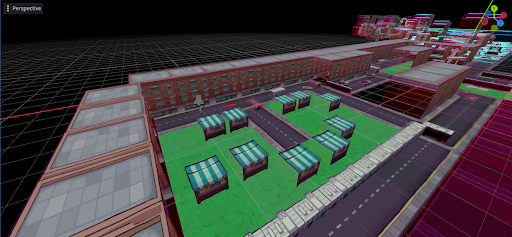
The transparency shader
This was the gnarliest piece. In real 3D the player constantly skates behind buildings, so those buildings need to fade out when they’re blocking the view.
The obvious approach is to take the player’s position on screen and run a screen-space shader that fades whatever’s in front of them. I tried that first. It didn’t work.
So I did it in 3D instead. I built a pyramid with its tip at the camera and its base anchored to the player’s four corners as seen from the camera. That pyramid covers exactly the space between the camera and the player. Any object poking into it is blocking the view, so it gets a transparency shader. The game tracks which objects are currently faded, lerps them in and out as you move, and strips the shader back off once they’re clear.
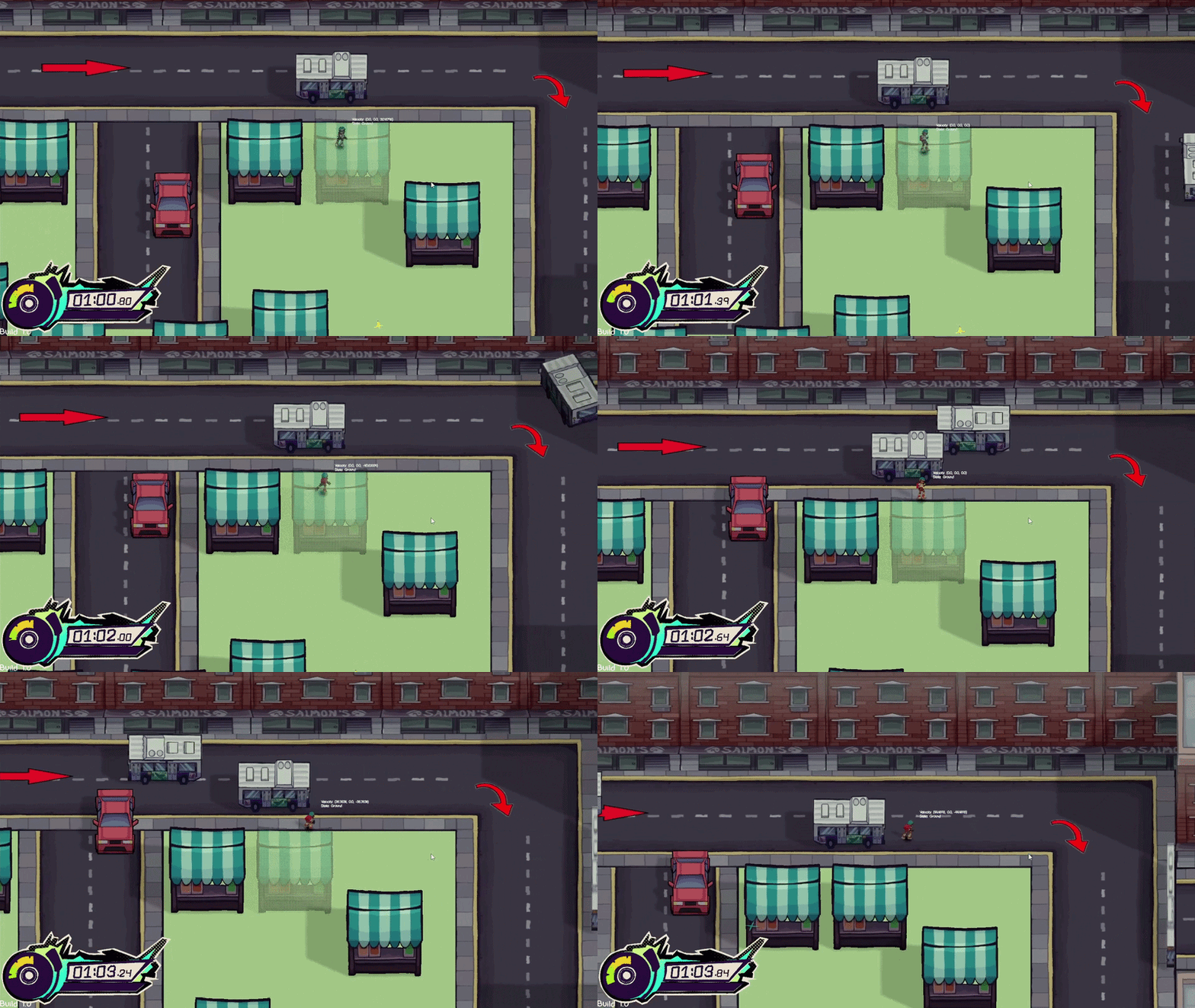
The transparency is dithered rather than a smooth blend. Our art is set to alpha-cut “discard” so the z-ordering works, which was a constraint from the asset pipeline that I inherited and didn’t get to change. Dithering fakes partial transparency with a pattern of fully-on and fully-off pixels, so it works with that hard on-or-off cutoff.
What the switch unlocked
Real shadows, actual light sources, and proper environment lighting, none of which fit the old setup. I also hooked the player animations into the controller and added the feel-good camera work. A screen shake when you crash, the field of view widening as you pick up speed, and the camera leaning ahead of you as you move. All of it is smoothed with lerping so it feels nice instead of jerky.
Looking back
The shader was the hardest code I wrote on this project. The prototype was the most important thing I made.
I’ve thought about this a lot since. On a team that size, an opinion in a meeting is one more opinion, no matter how right it is. A working demo of the thing you’re arguing for ends the conversation. I didn’t set out to learn that. I just got frustrated enough to build the demo. But it’s the part of this project I’d point to first.
Skating behind a building and watching it fade out is a close second.